 Illustrative
India now has more than 300 GW of power capacity that doesn’t burn fossil fuel. That is a milestone worth pausing on, and it raises a harder question: where will the next 200 GW go?
- Non-fossil capacity
- 300.5GW
- 2030 target
- 500GW
- Share of all capacity
- 54%+
- Added in FY 2025–26
- 55.3GW
Where India stands today
As of 31 July 2026, India’s non-fossil capacity stood at 300.50 GW, according to figures reported by Renewable Watch. That is more than 54% of the country’s total installed capacity of about 552 GW, and just over 60% of the 500 GW target India has set for 2030.
| Source | Capacity, 31 July 2026 |
|---|---|
| Solar | 164.59 GW |
| Wind | 58.14 GW |
| Hydro | 57.24 GW |
| Bio-power | 11.75 GW |
| Nuclear | 8.78 GW |
| Total non-fossil | 300.50 GW |
Solar now carries more than half of the clean-power fleet. It has grown from about 2.8 GW in 2014 to roughly 165 GW today.
The pace is real
India crossed the mark of 50% non-fossil installed capacity in June 2025, five years ahead of the 2030 goal it set under the Paris Agreement. In financial year 2025–26 it added a record 55.29 GW of non-fossil capacity, including 44.6 GW of solar and 6 GW of wind.
The arithmetic for the rest of the decade is simple. Reaching 500 GW means adding about 200 GW more by 2030, which works out to roughly 45 GW a year. Last year’s pace shows that is possible, if it can be kept up.
The hard part is land
Keeping that pace up is not only a question of panels and money. A parliamentary committee reviewing the target pointed to delays in land acquisition, bottlenecks in grid-connection approvals and inadequate storage as the main risks.
Land is the one that matters most for us. Solar is land-hungry: in mountain terrain, a plant needs about 2 hectares per megawatt, so a 10 MW plant commits around 20 hectares. Much of the suitable land in India is farmland or grazing land, and taking it out of food production for decades is a hard trade to make.
The next 200 GW will have to share land with farming, not replace it.
Agrivoltaics: sharing the land
Agrivoltaics means growing crops or grazing animals under or between solar panels, so one plot of land produces both power and food. Policy attention is starting to follow. Industry reports describe an agrivoltaics component, possibly around 10 GW, being discussed for the next phase of the government’s PM-KUSUM farm-solar scheme. The Ministry of New and Renewable Energy is also hosting an AgriVoltaics World Conference in New Delhi from 21 to 23 October 2026. No final national agrivoltaics guideline has been published yet, so these are signals rather than settled policy.
Why the hills belong in the plan
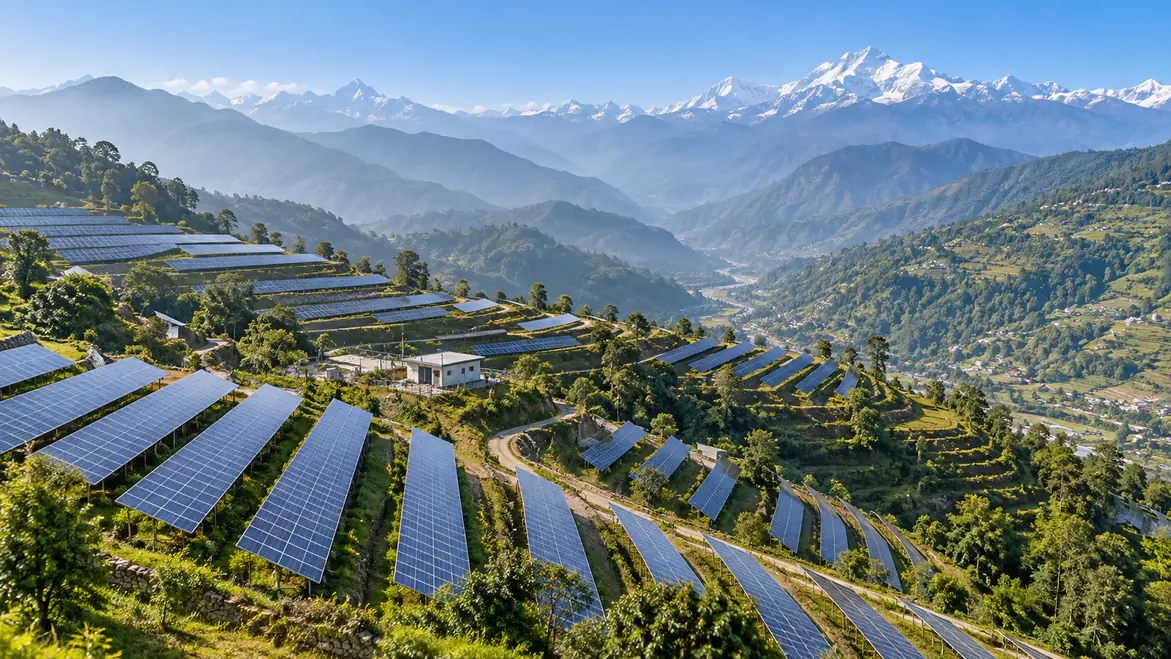
Most of India’s big solar parks are in the plains and the desert. The hills are usually left out, and the data suggests they shouldn’t be. Using Global Solar Atlas figures for the sites we compared, a south-facing Uttarakhand site produces 1,715.9 kWh per kWp a year, about 97% of a Rajasthan site’s 1,763.3. The mountain air is also about 11 °C cooler, and solar panels work better when they are cooler.
Uttarakhand has its own targets too. Its draft solar policy aims for 2,000 MW between 2023 and 2028, mostly distributed projects, with 50 MW earmarked for agriculture. Energy researchers have argued that the hill state suits smaller, decentralised plants better than giant farms. That is exactly the scale we work at: a 400 kW pilot today and a 2 MW block next.
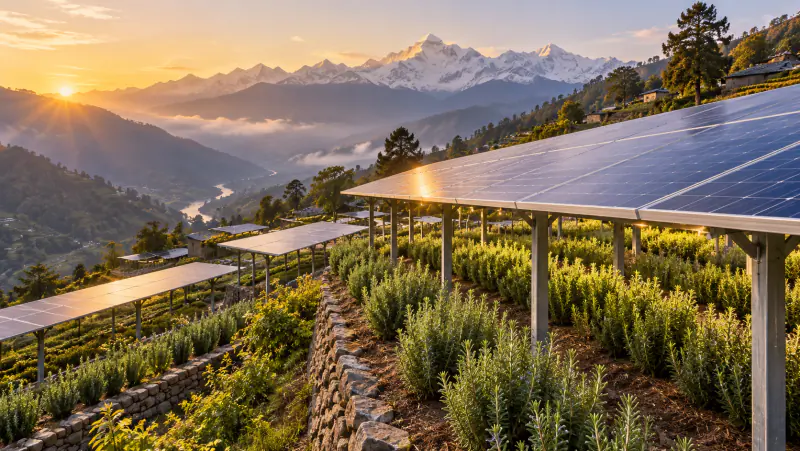
On hill land, the case for agrivoltaics is even stronger than in the plains. Terraces are scarce, mechanised maintenance is hard, and leaving the ground under the panels bare costs money and invites erosion. Putting a crop like rosemary under the panels, or a managed flock, turns that cost into a second income.
What it means for Agrivolta
Our 400 kW pilot shows the hill version works: elevated panels generating power, with rosemary growing beneath them. As India pushes toward 500 GW, we think hill agrivoltaics can add clean capacity without taking land away from farming, and add farm income where it is most needed.
Sources
- Renewable Watch — India crosses 300 GW non-fossil fuel power capacity (11 Aug 2026): capacity, breakdown, FY 2025–26 additions.
- News On AIR — India achieves 50% clean power capacity five years ahead of target (Jul 2025).
- SolarQuarter — parliamentary committee on the 500 GW target (Dec 2025): risks on land, connectivity and storage.
- International Climate Initiative — AgriVoltaics World Conference 2026, New Delhi, 21–23 Oct 2026.
- Mercom India — Uttarakhand’s draft solar policy targets 2,000 MW by 2028.
- Mongabay India — solar as a dependable alternative for Uttarakhand: decentralised plants in the hills.
- Global Solar Atlas: PV output and temperature for the compared Uttarakhand (1,381 m) and Rajasthan (305 m) sites.