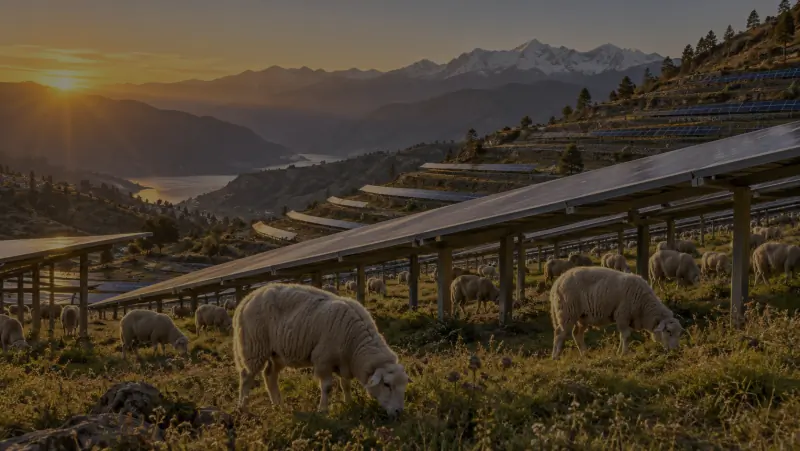
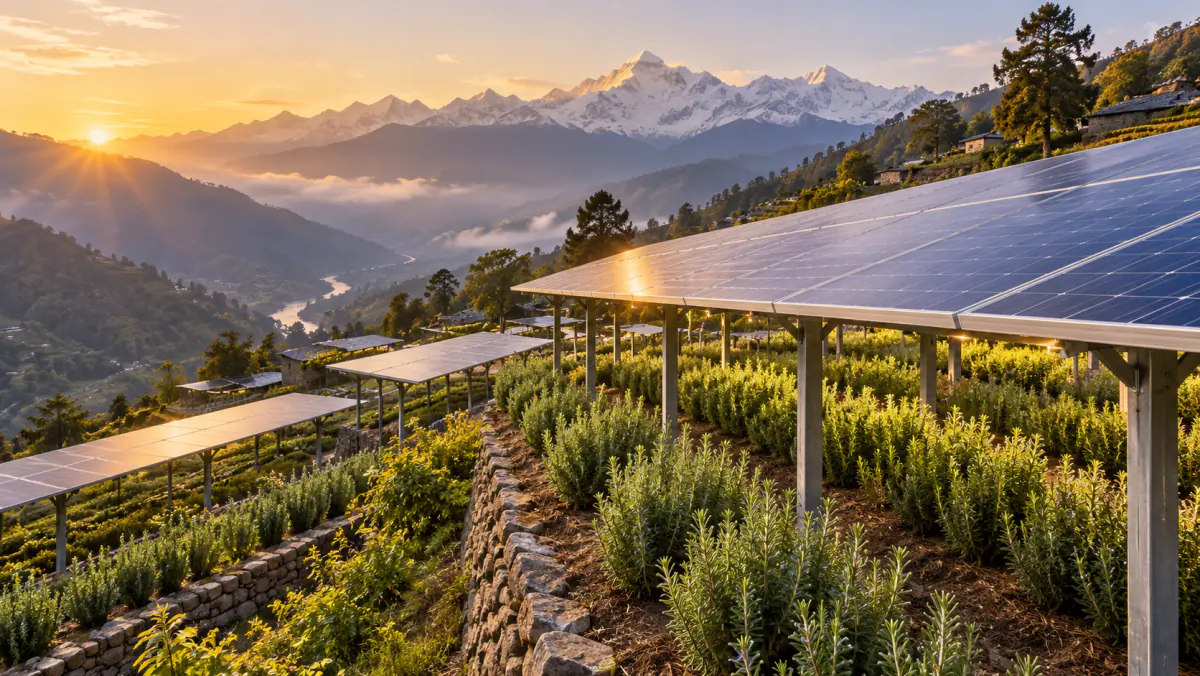
 Concept visualisation
On a south-facing hillside in Uttarakhand, a 400 kW solar plant is doing two jobs at once. Above, its panels generate clean power. Below, 5,000 rosemary plants are taking root in ground that would otherwise sit idle — and cost money to keep clear.
This is Agrivolta’s operating pilot, and it is the clearest way we know to explain what mountain agrivoltaics means in practice: one structure, one land parcel, two harvests.
- Solar capacity
- 400kW
- Energy generated
- 5,44,625kWh
- CO2 avoided
- 431t
- Rosemary planted
- 5,000
The problem with idle ground
Hill solar has a hidden cost. The terrain that gives Uttarakhand its strong solar resource also makes conventional operations hard to scale. Tractors and standard equipment can’t move safely across steep terraces, so cleaning and weed control stay labour-led. On our own 400 kW site, cleaning alone runs ₹5,000–10,000 a month, and weeds return every season. Runoff and loose hill soil add another risk, disturbing access paths and exposing foundations.
Mountain farmers face the mirror image of this problem. High-value crops need capital for plants, irrigation and labour long before the first harvest. Growers hesitate to take on non-staple crops without proven yields and a buyer. And fresh and dried herbs need reliable offtake, storage and price visibility.
Put those two lists side by side and an opportunity appears: a costly ground layer under the panels, and farmers who need a de-risked way into a high-value crop.
Why rosemary, and why elevated panels
Our structure lifts the solar tables on pile-founded steel columns while keeping the panel geometry and a 25° tilt tuned for generation. The key dimensions are simple:
- 1.5 m low edge — enough working clearance to keep service corridors open.
- 2.6 m bay width between supports.
- 900 mm plant-height zone — rosemary is a low, perennial shrub that stays well under the panels.
- Ø300 mm pile foundations, with the rosemary root zone working around them rather than competing with them.
Rosemary suits this setup. It is perennial, so it is planted once and holds the soil year-round. It stays low enough not to shade the modules or block maintenance. And it is a herb with growing demand, which matters as much as the agronomy.
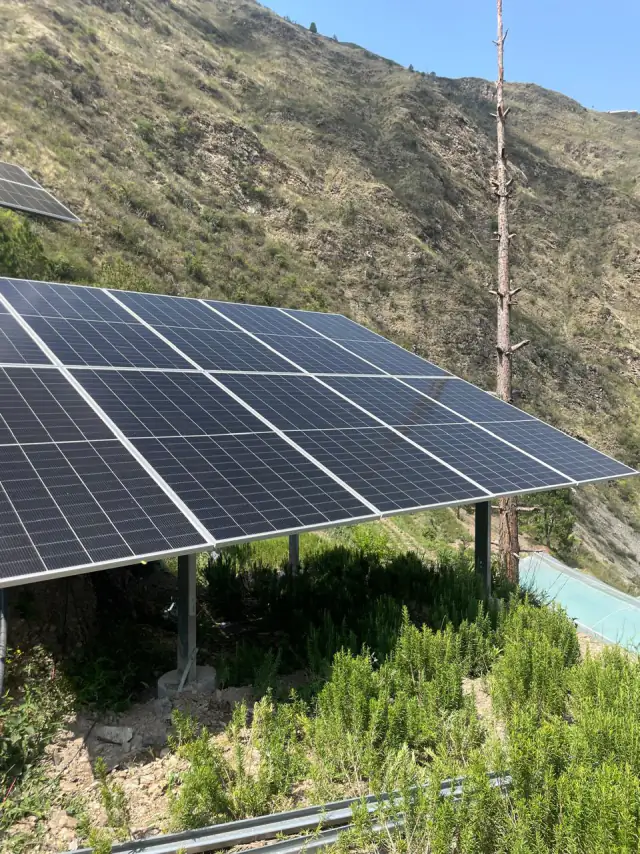 Actual pilot site
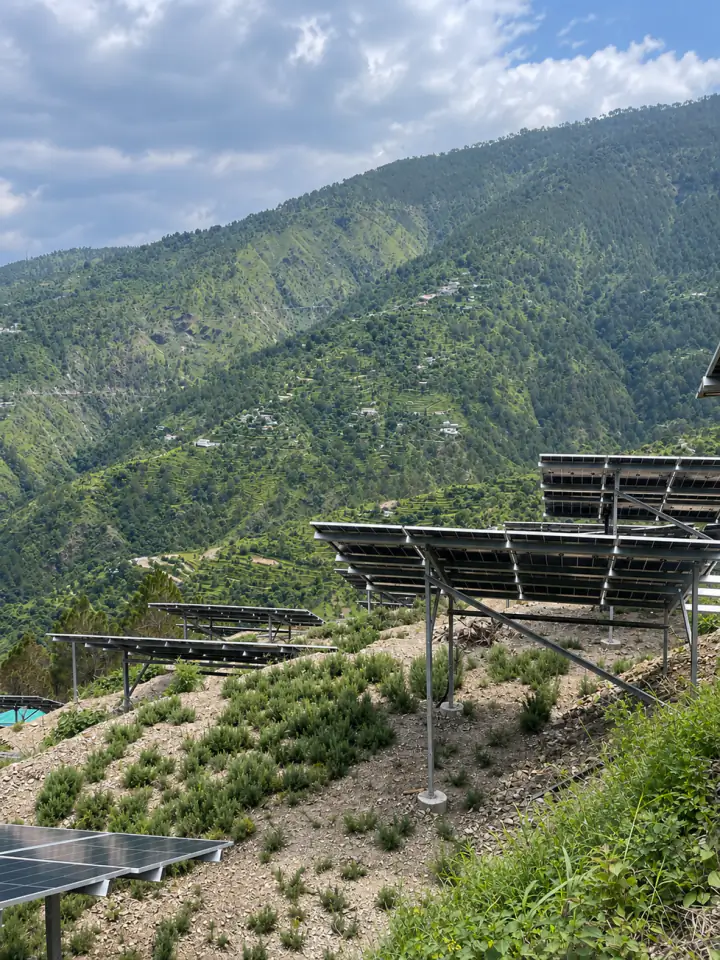 Actual pilot site
Rajasthan-class sun, Himalayan-cool panels
It is easy to assume the hills are a second-best place for solar. The data says otherwise. Using Global Solar Atlas figures for the sites we compared, a south-facing Uttarakhand location (1,381 m) produces 1,715.9 kWh/kWp a year, against 1,763.3 kWh/kWp for a Rajasthan site (305 m) — about 97% parity.
The Uttarakhand site also averages 15.0 °C against Rajasthan’s 26.3 °C. Solar modules lose efficiency as they heat up, so cooler mountain air can help real-world output. Hill solar isn’t a compromise. It’s a resource India hasn’t used much yet.
What the pilot shows so far
The pilot covers 10,000 m². At full under-panel use, that area can hold about 20,000 rosemary plants. Today 5,000 are in the ground — 25% of capacity. At an assumed 300 g of yield per plant per year, that is roughly 1.5 tonnes of harvest potential now, rising to 6 tonnes at full capacity.
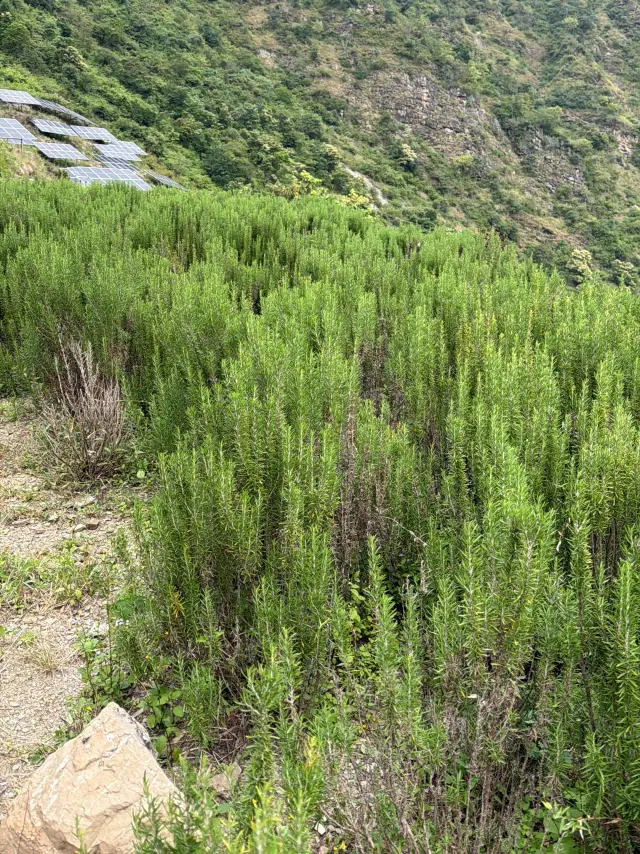 Actual pilot site
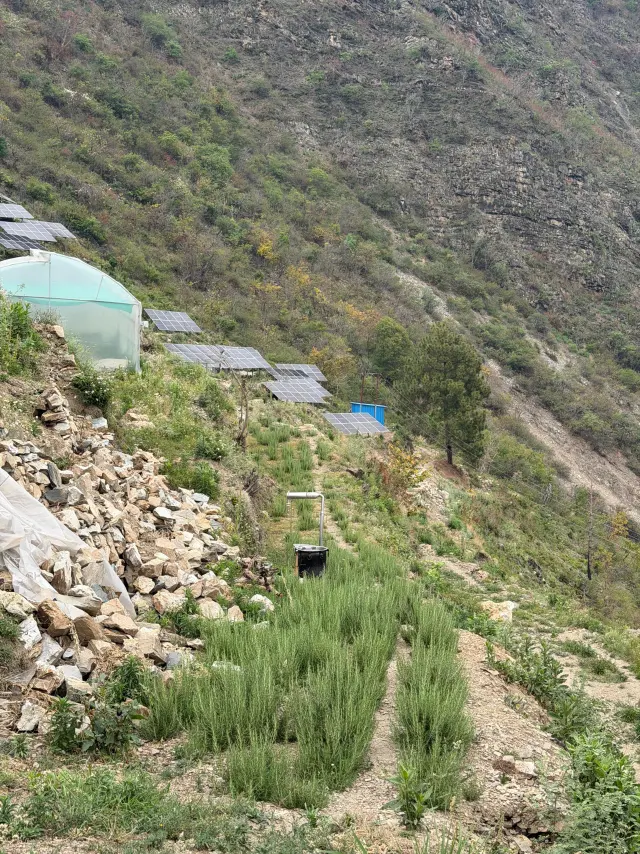 Actual pilot site
The site has generated 5,44,625 kWh of clean power, avoided an estimated 431 tonnes of CO2, and supports five farmers.
Being honest about what’s proven. The pilot demonstrates physical integration: the structure, the crop and the slope work together. The yield figures above are potential based on a 300 g-per-plant assumption. Our next validation step is realised yield, harvest cycles and market offtake.
The economics: a second income layer
We model profit as an index, with a solar-only plant set at 100. Planting the suitable ground beneath the panels adds herb income on the same footprint without touching generation:
| Under-panel area planted | Rosemary plants | Profit vs solar-only |
|---|---|---|
| 0% (solar only) | 0 | 100 |
| 25% (pilot today) | 5,000 | 121 (+21%) |
| 50% | 10,000 | 142 (+42%) |
| 75% | 15,000 | 163 (+63%) |
| 100% (full capacity) | 20,000 | 183 (+83%) |
This is an indicative model, and we’ll check it against realised yields. But the direction is clear. The ground under a solar plant can earn money instead of costing it.
The market is growing too. India’s non-fossil power capacity stands at about 300.5 GW against a 500 GW target for 2030. India’s fresh-herbs market is projected to grow from US$542 million to US$994 million by 2030, a 10.6% CAGR, with rosemary growing at 7.6%.
Next: a 2 MW block
The next milestone takes the same structure, crop and playbook five times bigger:
- 2 MW of solar, up from 400 kW
- 5 ha (50,000 m²) of land
- 1,00,000 rosemary plants of capacity
- ~30 t of fresh-herb potential a year (1,00,000 × 300 g)
What stands between us and megawatts
We’ve shown the structure, crop and slope can work together. Scaling up now depends on four things:
- Capital. MW-scale agrivoltaics needs upfront money for solar, elevated structures, irrigation and crop establishment before returns begin.
- Policy. Uttarakhand doesn’t yet have a clear framework or targeted support for large agrivoltaic projects.
- Power offtake. Scale depends on bankable long-term PPAs, and willing corporate buyers and DISCOM-backed agreements are still hard to secure.
- Mountain execution. Steep terrain makes installation, logistics, labour and maintenance harder than on flat land.
We have shown the model works at 400 kW. The next step is building the partnerships to take it to megawatts.
That is why we are looking for partners in four places: capital partners (growth equity, structured debt or project finance), power offtakers (corporate buyers, utilities or DISCOM-backed PPAs), policy partners (agrivoltaics recognition, clearer approvals and hill-region incentives) and execution partners (EPC, logistics and agricultural teams with mountain experience). We are also looking for buyers of fresh and dried rosemary.