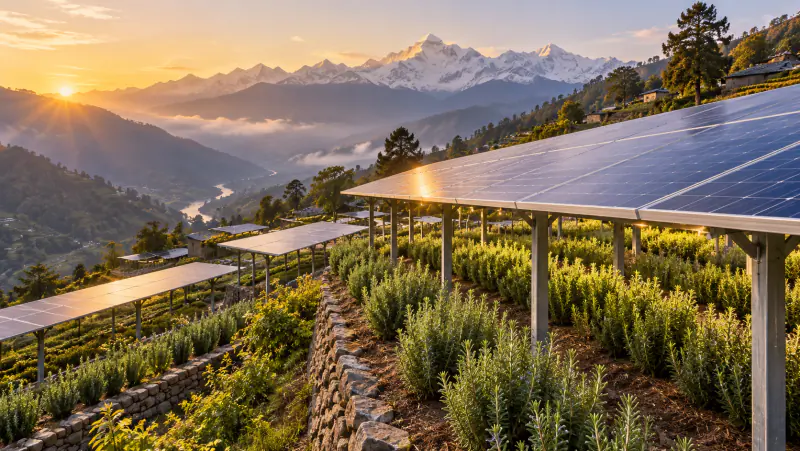
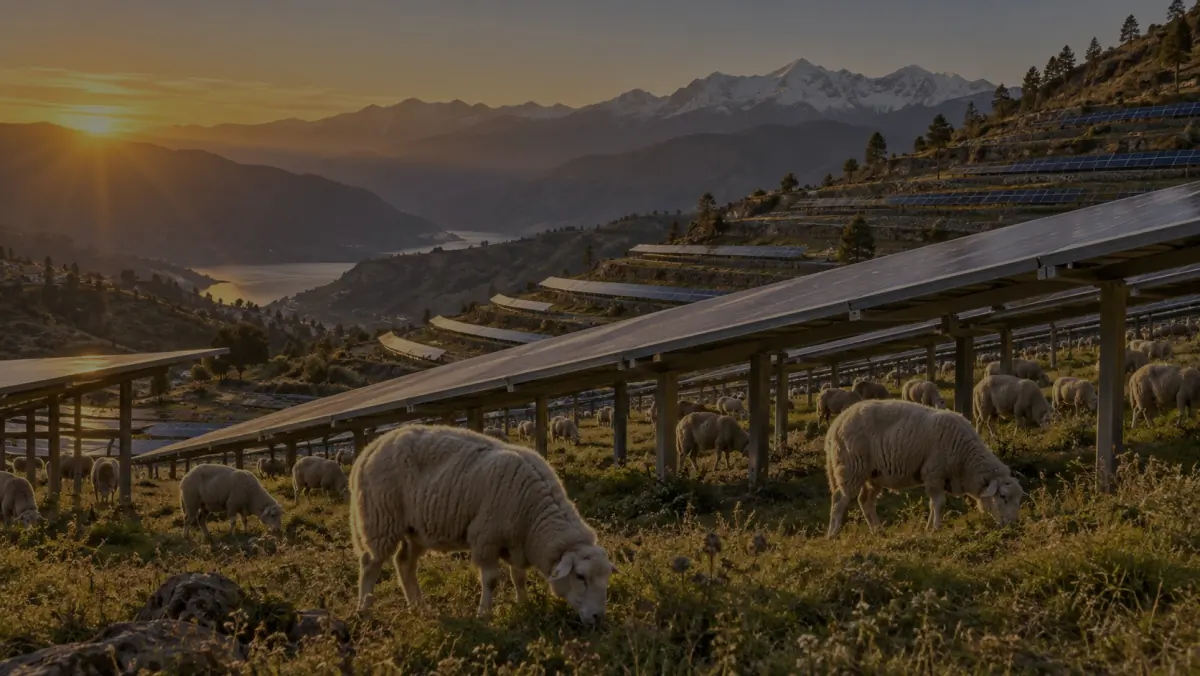
 Concept visualisation
Every hill-solar plant has a line in its budget that does nothing productive: paying people to cut back the vegetation under the panels. We think that line could pay for itself instead, with a managed flock of fine-wool Merino sheep.
This is the second model in Agrivolta’s roadmap. Our rosemary pilot is already operating. Solar grazing is in validation. It is a working model, not a guaranteed rollout, and this piece explains both the opportunity and what we still need to prove.
- Reference site
- 10MW
- Hill land
- ~20ha
- Target flock
- ~160sheep
- Wool fineness
- ~19µm
Hill solar pays to keep its land idle
In mountain terrain, solar needs about two hectares per megawatt. A 10 MW plant therefore takes up around 20 hectares of hill land — land that competes with grazing and farming, and that usually sits barren under the panels.
That ground still needs looking after. At ₹5,000–10,000 per hectare per month, vegetation management for a 10 MW hill plant costs ₹12–24 lakh a year. And because steep slopes rule out mechanised mowing, that work stays manual.
Solar takes up valuable hill land, and operators still pay every year to keep that land unproductive.
The model: elevate, shade, rotate, fertilise
Our grazing design uses the same idea as our rosemary structure: raise the panels so the ground below can work. For sheep, that means:
- Elevate. Raised tables with about 1.5 m of clear height and a 2.8 m bay leave room for sheep, which stand around 900 mm tall, to move beneath the modules.
- Shade. The panels become cooler rest zones that reduce heat stress for the flock.
- Rotate. Planned paddock moves stop overgrazing and let the pasture regrow.
- Fertility. Droppings return nutrients to the soil and improve the pasture over time.
Engineering caveat. The grazing structure still has to be checked by a structural engineer for wind load, clearance, cable protection and safe movement for the animals.
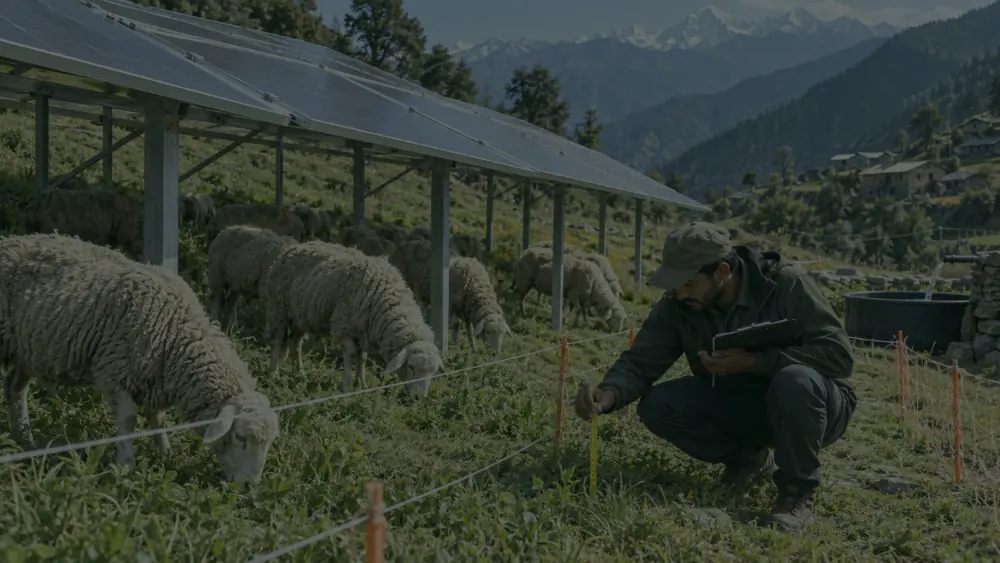 Illustrative
Managed grazing, not free grazing
Turning a flock loose on a solar site would be a liability. We run the flock as a professional vegetation-control service, in a four-step cycle:
- Plan paddocks. Map grazing blocks and vegetation targets.
- Fence and water. Temporary electric netting or polywire, water points and shaded rest zones.
- Graze and measure. Move the flock based on vegetation height and sheep-days per hectare.
- Rest and regrow. Let the ground recover, with residual mowing only where grazing can’t reach the target height.
Around that cycle sit daily shepherding and vegetation-height checks, feed supplementation in lean months, and safety rules for cables, inverters and livestock.
Why Merino: premium fibre, not commodity grazing
The choice of animal is what turns an O&M service into a textile business:
- ~19 micron wool. Fine-wool Merino crossbreeds create premium potential.
- Wool only. A cleaner model, with no meat-trading business.
- Hill fit. A cooler climate and slopes suit managed grazing.
- Textile insight. The team’s family background in fabrics helps with buyer access and supply-chain mapping.
Uttarakhand has already invested in this genetics. In December 2019, under the National Livestock Mission, the state government imported 240 high-quality Australian Merino sheep to improve local wool quality.
The economics: lower O&M, new wool revenue
For the 10 MW / ~20 ha reference site, per year:
| Today | With sheep | |
|---|---|---|
| Vegetation O&M cost | ₹18L | ₹4.5L (−75%) |
| Wool revenue | ₹0 | ₹5.4L avg (₹2.4–8.4L range) |
| Gross value created | ₹0 | ₹18.9L |
These figures assume a 75% reduction of an ₹18L annual vegetation bill, plus average wool revenue from a ₹2.4–8.4L range. Sheep operating costs are excluded, which is why we call it gross value. The case rests on the O&M savings. Wool is extra upside that also makes the business harder to copy.
Proven abroad, adapted for Uttarakhand
Solar grazing is not a new idea, and other countries show how it can work:
- USA — grazing as a service. Specialist graziers are paid to manage vegetation across multi-site solar portfolios.
- France — agrivoltaics by design. Solar parks are planned from day one with livestock access, water, fencing and forage.
- Germany — ecological land management. Sheep support biodiversity-focused solar sites, often alongside residual mowing and seasonal movement.
Our version for Uttarakhand combines grazing-as-a-service with premium fibre: grazing that cuts O&M costs, plus 19-micron Merino genetics that add textile upside. In the long run, that points to a specialised solar vegetation-management company with central flock operations and wool aggregation.
What we still need to prove
We plan to scale in stages, and each stage has to prove itself on hill solar before the next one starts:
- Field pilot. Validate sheep-days per hectare, how much vegetation height drops, table clearance and cable safety.
- 10 MW reference unit. Test residual mowing, shepherding, feed supplementation, vet costs and how much the wool actually sells for.
- Scale only if proven. Prove shared flock operations, mobile handling, shearing, wool aggregation and multi-site service economics.
Along the way we will measure labour reduction, stocking density, feed supplementation, mortality, wool micron and fleece yield, buyer prices, soil impact and any cable-safety incidents. The impact case covers money saved per hectare, kilograms of wool, soil organic matter, biodiversity and income for shepherds and farmers.
Who we need
- Solar and O&M operators — pilot access, site-safety protocols and vegetation-management benchmarks.
- Merino and veterinary partners — breed sourcing, animal health, monitoring and seasonal flock management.
- Textile offtake partners — micron testing, wool grading, buyer quotes and a traceable fibre channel.
- Capital and policy partners — pilot funding, working capital, approvals and support for hill-region agrivoltaics.